

A good match starts with reading the old pattern: how big the bumps are, how flat they were knocked down and how far apart they sit. Then the patch is made flat, primed and tested before texture goes on the wall. Estimates are free and carry no obligation: phone (801) 735-8491, or tell us in the estimate form which room it is and what the texture looks like.
The textures you'll find on Salt Lake City walls and ceilings
Most drywall texture is joint compound or a texture product, thinned with water and sprayed or troweled on. One gypsum maker's spray texture is built for three standard patterns: orange peel, spatter, and spatter with knockdown. Each pattern needs its own mix, so the first step in any match is naming the pattern on your wall.
- Orange peel: a fine spray that dries into small, close bumps like the skin of an orange. It uses the thinnest mix of the three sprayed patterns.
- Spatter: larger drops of a thicker mix, left to dry as raised dots.
- Knockdown: spatter that is flattened with a wide knockdown knife once it loses its wet shine, leaving flat-topped islands.
- Skip trowel: compound swept on by hand with a curved trowel so it skips across the surface, leaving scattered, flattened blobs.
- Smooth: no texture at all, with the surface finished so paint shows no seams or patches.
How a patch is blended into existing texture
A texture match only works on a flat patch. The repair is filled, sanded and feathered out past its edges first, because texture laid over a bump makes the bump easier to see. One texture maker's data sheet warns that uneven surfaces are accentuated by sharp, angular lighting, like window light running along a wall.
Next, the old pattern is read up close: drop size, how far apart the drops sit, how flat they were knocked down and how thick the texture stands. The same data sheet tells applicators to try the mixed material and adjust the water to suit the job, so the spray goes onto scrap board or cardboard until it looks like the wall.
The primed patch is textured from the center out, lighter toward the edges, so the new pattern fades into the old. Knockdown is flattened once it loses its wet shine, to the same flatness as the original. When the spot sits in the middle of an open wall, the texture is carried out to a corner or other natural break.
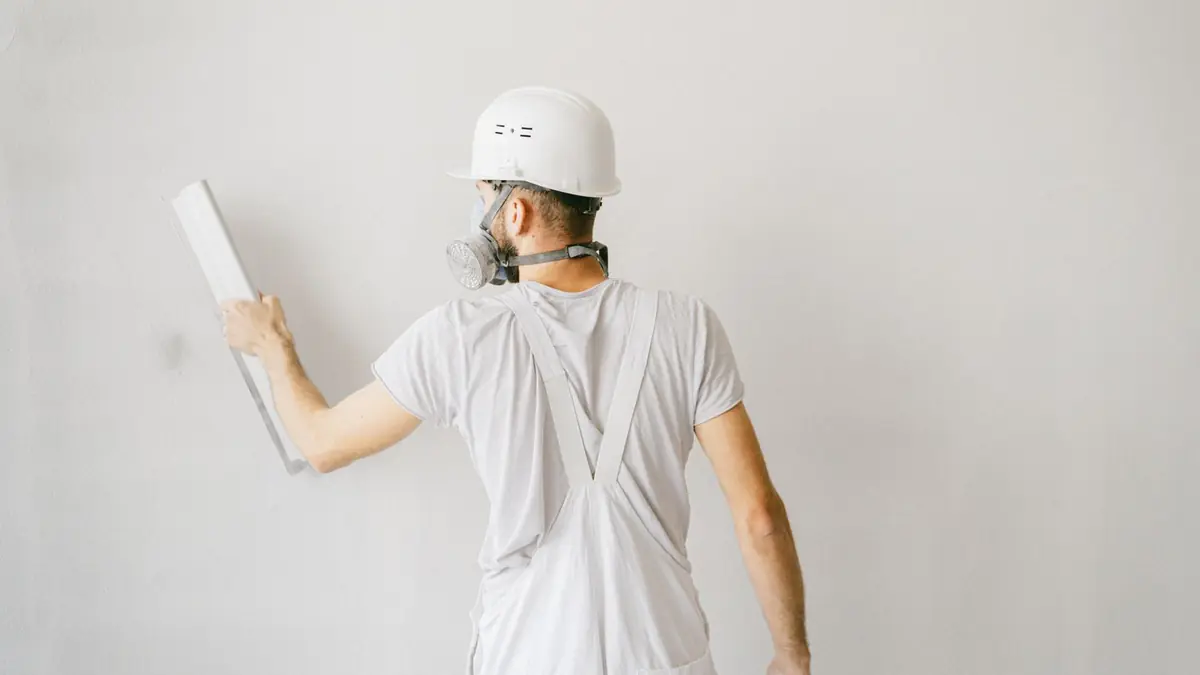 Sample photo
Why a textured patch still shows, and what fixes it
USG's construction handbook is blunt: touching up a textured surface so it completely blends with the texture around it is extremely difficult. When a touch-up stands out, the handbook traces it to a difference in either the texture or the color.
Color differences usually come from suction. A joint or patch that soaks up more water than the board around it causes a texture variation that often shows as a color contrast, a white band or flashing. Texture sprayed over compound that is still damp, especially in cold or humid weather, can darken the joint. USG's prevention for both is a prime coat before texturing, and its remedy is to let the texture dry and paint the entire surface.
The mix matters too. Too much water thins the binder, so the texture bonds poorly, hides the joint poorly or builds up over it. When careful touch-up still doesn't disappear, USG's remedy is to re-texture the entire wall or ceiling, which is why a large patch in open wall is often finished corner to corner.
Plaster walls in Salt Lake City's older homes
Salt Lake City has a deep stock of prewar housing: nearly one home in four was built in 1939 or earlier, by Census Bureau estimates for 2024. The National Park Service says that until the 1930s or 1940s almost every building got plaster walls, so a patch in one of those houses is often a plaster match, not a drywall one.
Old plaster may be smooth-troweled or have a sand finish, and it is rarely flat. The Park Service's plaster guide says a patch on a slightly wavy wall should follow the wall's contour, because a flat patch will stand out from the rest of the wall. So the patch is built up and shaped to the old surface first, and the finish on top is chosen to match the plaster around it.
Going from textured walls to smooth ones
Some jobs are the opposite of a match: an old orange peel or knockdown wall made smooth. That is done with skim coats of joint compound over the whole surface, sanded between coats until the texture is gone. National Gypsum describes the top finish level, Level 5, as a skim coat over the entire surface, and says it is typically specified for glossy or deep-tone paint and for critical lighting.
Prep matters as much as the skim. The surface has to be sound and clean, and the texture maker's prep directions say to dull glossy surfaces before anything goes over them. Loose or peeling texture is scraped off first, because a skim coat is only as strong as what it sits on. After the last coat, the wall is primed so the paint dries evenly.
What changes the cost of texture work
We don't post prices, because texture jobs vary a lot from house to house. These are the things that move an estimate up or down:
- How many patches there are and how big they are
- The pattern, since hand-troweled skip trowel takes longer than a sprayed orange peel
- Ceiling work and tall walls in stairwells or vaulted rooms
- Plaster or drywall
- Whether the whole wall or ceiling needs re-texturing, primer and paint so the patch disappears
- Testing for asbestos or lead first in an older home
Questions about drywall texture and matching in Salt Lake City
Can you match my existing texture exactly?
Often it can be matched closely, but not always perfectly. Common sprayed patterns like orange peel and knockdown are the easiest to copy, and a repair blends best when the whole wall is painted afterward. Very old, heavily painted or hand-troweled texture is harder, and if a patch still shows, re-texturing the full wall or ceiling is the fix.
Can knockdown or orange peel go on a ceiling?
Yes. Spray textures are made for walls and ceilings. On a ceiling, the board has to be thick enough for the spacing of its framing, because USG notes that water-based textures wet the face paper and can make ceiling panels sag.
Do I need to paint after texturing?
Yes. Spray texture dries white and isn't washable until it's painted, and its makers say to paint over it once it's dry. Primer and paint also even out the color between old and new texture.
Is there anything to check before patching walls in an older home?
Yes. Patching compounds and textured paints made before the 1977 federal ban could contain asbestos, and in a home built before 1981, Utah requires an inspection of the materials in the work area before disturbing more than three square feet. Homes built before 1978 may also have lead paint, which Utah's Division of Air Quality regulates for paid contractors.
What should I tell you when I ask for an estimate?
The room, whether the texture is on a wall or ceiling, what it looks like and roughly how big the damaged area is. Call (801) 735-8491 or put those details in the estimate form's message. Estimates are free and there's no obligation.
Towns We Serve for Drywall Texture & Matching
Sources
- Gypsum Construction Handbook, chapter 12: texture finish problems, poor touch-up, flashing, joint darkening, ceiling sag (USG / CGC)
- Sheetrock Wall and Ceiling Spray Texture submittal sheet: patterns, water for orange peel vs knockdown, test the mix, lighting, dull glossy surfaces (USG)
- Sheetrock Brand Wall and Ceiling Spray Texture submittal sheet: prime coat, not washable unpainted (USG)
- Sheetrock Brand Wall and Ceiling Spray Textures product page (USG)
- Gypsum board finish levels, Level 5 skim coat (National Gypsum)
- How to apply knockdown and skip trowel texture (Bob Vila)
- Preservation Brief 21: Repairing Historic Flat Plaster Walls and Ceilings (National Park Service)
- Year structure built, Salt Lake City, ACS 2024 1-year, table B25034 (U.S. Census Bureau, via Census Reporter)
- Asbestos in the home: patching compounds and textured paints, 1977 ban (Consumer Product Safety Commission)
- Renovation or Demolition? What You Need to Know Before You Start: renovation definition and inspection by build year (Utah Division of Air Quality)
- Lead-Based Paint Program: pre-1978 homes and paid contractors (Utah Department of Environmental Quality)