

Call (801) 735-8491 or use the estimate form, and say whether the walls will be textured, flat-painted or glossy, since that decides how many coats the job needs.
What taping and finishing involves, coat by coat
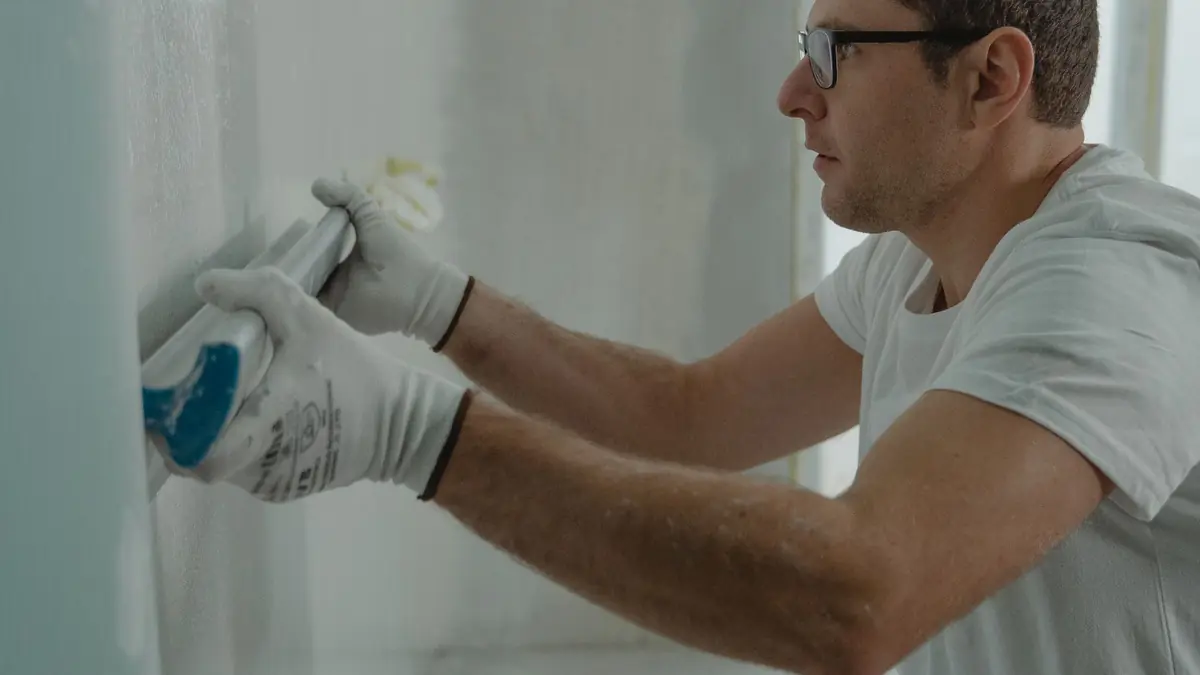
The first coat beds tape in joint compound over every flat joint and inside corner, and each screw head and strip of corner bead gets its own coat. Later coats widen and feather the joints so they sit flat with the board around them.
Each coat has to dry before the next goes on. USG's handbook warns that coating over wet compound causes delayed shrinkage, sometimes called starved joints, where a joint sinks after it looks finished. The cure is enough drying time between coats or a low-shrink setting compound.
Before paint or texture, the whole surface gets primer, which USG says keeps joints from showing as dull or shiny bands. USG also recommends checking joints with a strong work light held parallel to the wall, which shows ridges and hollows that overhead light hides.
The six levels of drywall finish, Level 0 to Level 5
The Gypsum Association's GA-214 standard sets six levels of finish. Builders, designers and owners use them to agree on how the walls will look before work starts. Here is what each level includes and where the standard says it is typically used:
- Level 0: no taping or finishing. For temporary work, or when the final finish hasn't been decided.
- Level 1: tape set in compound at joints and inside corners. For areas out of sight, such as above ceilings and in attics.
- Level 2: tape embedded and wiped with a thin coat, plus one coat on screws and corner bead. For a tile base, and for garages and storage areas where looks don't matter.
- Level 3: one more coat on joints and two on screws and bead. For walls getting a medium or heavy spray or hand texture.
- Level 4: two more coats on flat joints and three on screws and bead. For flat paint, light texture or wallcovering.
- Level 5: everything in Level 4, plus a thin skim coat over the entire surface. For gloss or sheen paint, dark colors and walls under strong side light.
 Sample photo
Choosing between Level 4 and Level 5 for smooth walls
For a smooth painted wall, GA-214 points to Level 4 or Level 5, depending on the paint and the light. Level 4 suits flat paint. The standard does not recommend paint with sheen or dark, deep tones over Level 4, and says a light texture under flat paint can help hide joints where lighting is harsh.
Level 5 adds a thin skim coat over the whole surface. GA-214 calls it the most effective way to get a uniform surface and keep joints and fasteners from showing through the paint. It is the level for eggshell, satin or gloss paint, dark colors, and what the standard calls critical lighting.
USG adds that strong side light hitting a wall at a low angle makes gloss differences over joints stand out. In a home, that means walls beside tall windows, long hallways lit from one end, and walls washed by lights mounted close to the surface.
Setting compound or ready-mixed compound: what each one does
Joint compound comes in two families. Drying-type compound comes ready-mixed in a pail and hardens as its water evaporates. Setting-type compound is a powder mixed on site that hardens by a chemical reaction, with versions that set in 20, 45 or 90 minutes, according to USG.
Each has its job. USG's handbook says setting-type compounds have the best built-in resistance to cracking and shrink less, which suits embedding tape and filling deep spots. The National Park Service notes they are hard to sand, so ready-mixed compound is the usual choice for the final coat.
The wrong product causes trouble. USG lists topping compound used for taping, and compound thinned with too much water, among the causes of cracks along the edges of tape.
Paper tape or mesh tape for drywall joints
USG tested both tapes with both kinds of compound. Paper tape reinforced the joint when the boards pushed together, bent or slid past each other, and worked well with either compound. Fiberglass mesh tape was stronger only when the boards pulled apart, and it let cracks show at lower loads as the mesh stretched.
USG's conclusion is that paper tape is the best choice for strong, crack-resistant joints with all compounds. If mesh tape is used, the first coat over it must be a setting-type compound, because mesh with ready-mixed compound made a much weaker joint. USG also recommends paper tape for inside corners and where walls meet ceilings.
How Salt Lake City's dry summers and cold winters affect drying
Salt Lake City's air is dry for much of the year. NOAA's long-term records for the airport show average afternoon humidity of 21 percent in July and 23 percent in August, against 70 percent in January.
USG's drying chart shows why that matters. In a 70°F room, joint compound dries within 24 hours at any humidity up to 67 percent. In very dry, warm or drafty air it can dry too fast, which USG lists as a cause of narrow cracks along the edges of the tape. USG's fixes are setting-type compound for taping, covering openings to stop drafts, and raising the humidity in a very dry room.
Winter brings the opposite problem. USG says joint compounds, textures and paints must be used at 55°F or warmer; below that, drying slows and the bond weakens, which can mean cracked joints and peeling finishes. USG recommends heat from the building's own system, because unvented heaters add water vapor and fumes that can stain the finish.
What affects the cost of taping and finishing
The level of finish sets the number of coats, so it shapes the price. Other factors:
- Square footage, and the number of joints, corners and openings
- Ceiling height and stairwells
- A smooth wall, or texture to follow
- Board that was hung poorly and needs fixing first
- Heat and extra drying time in cold weather
Questions about drywall taping and finishing in Salt Lake City
How long does joint compound take to dry between coats?
About a day in a warm room. USG's chart shows ready-mixed compound drying within 24 hours at 70°F when humidity is 67 percent or lower, or at 60°F when it is 50 percent or lower. Setting compound hardens in 20 to 90 minutes, depending on the type.
Can drywall be finished in winter?
Yes, if the space stays at 55°F or warmer, the minimum USG sets for joint compound, texture and paint. The building's own heating works best, since unvented heaters add moisture and can stain the surface.
Why do my drywall seams show through the paint?
Usually because paper and compound absorb paint differently. USG says gloss paint and strong side light make it worse. A prime coat prevents most of it, and a skim coat over the whole wall is USG's fix before gloss paint.
Why is there a raised ridge along a joint months later?
That is called ridging. USG explains that board swells and shrinks with temperature and humidity, and the stress bows the panel at the joint. USG advises waiting for the ridge to fully form, usually about six months, then sanding it down and feathering new compound over it.
Towns We Serve for Drywall Taping & Finishing
Sources
- GA-214-2022 Recommended Levels of Finish for Gypsum Panel Products, quick reference guide (Gypsum Association)
- Matching joint compound with the proper joint tape, white paper J2140 (USG)
- Finishing gypsum panels in cold or humid conditions, J850, with drying times by temperature and humidity (USG)
- Gypsum Construction Handbook, chapter 12: Problems, Remedies and Preventive Measures (USG / CGC)
- Comparative Climatic Data: average relative humidity, morning and afternoon, Salt Lake City 1948 to 2018 (NOAA NCEI)
- Preservation Brief 21: Repairing Historic Flat Plaster, Walls and Ceilings, patching materials (National Park Service)